Published July 14, 2026 · by Glacier Roofing
Key takeaways
- Water rarely enters directly above the ceiling stain; the real entry point is usually uphill.
- The most common Whatcom County leak sources are flashing, cracked pipe boots, valleys, nail pops, and wind-lifted shakes.
- Finding the true source takes a real inspection and often a water test, not a guess from the ground.
- Most roof leaks are honest repairs, not full replacements.
- For an active leak, tarp first; our local Whatcom County crews can respond fast — often same-day.
You spot a brown ring spreading across the ceiling, and your first instinct is to look at the roof right overhead. In Whatcom County, that’s almost always the wrong place to look. Between our wet Pacific Northwest winters — about 35 inches of rain a year in Bellingham, far more up in the foothills — the hard outflow winds that funnel down the Nooksack and Fraser valleys, and salt air near the water, roofs here leak in specific, findable ways. The good news: most of those leaks are repairs, not replacements.
Water rarely enters your roof right above the ceiling stain. It travels along the sheathing and down the rafters before it drips, so the true entry point is almost always uphill of the stain. In Whatcom County the common sources are failed flashing, cracked pipe boots, open valleys, backed-out nail pops, and wind-lifted shakes or shingles — nearly all of them fixable.
Why is my roof leaking?
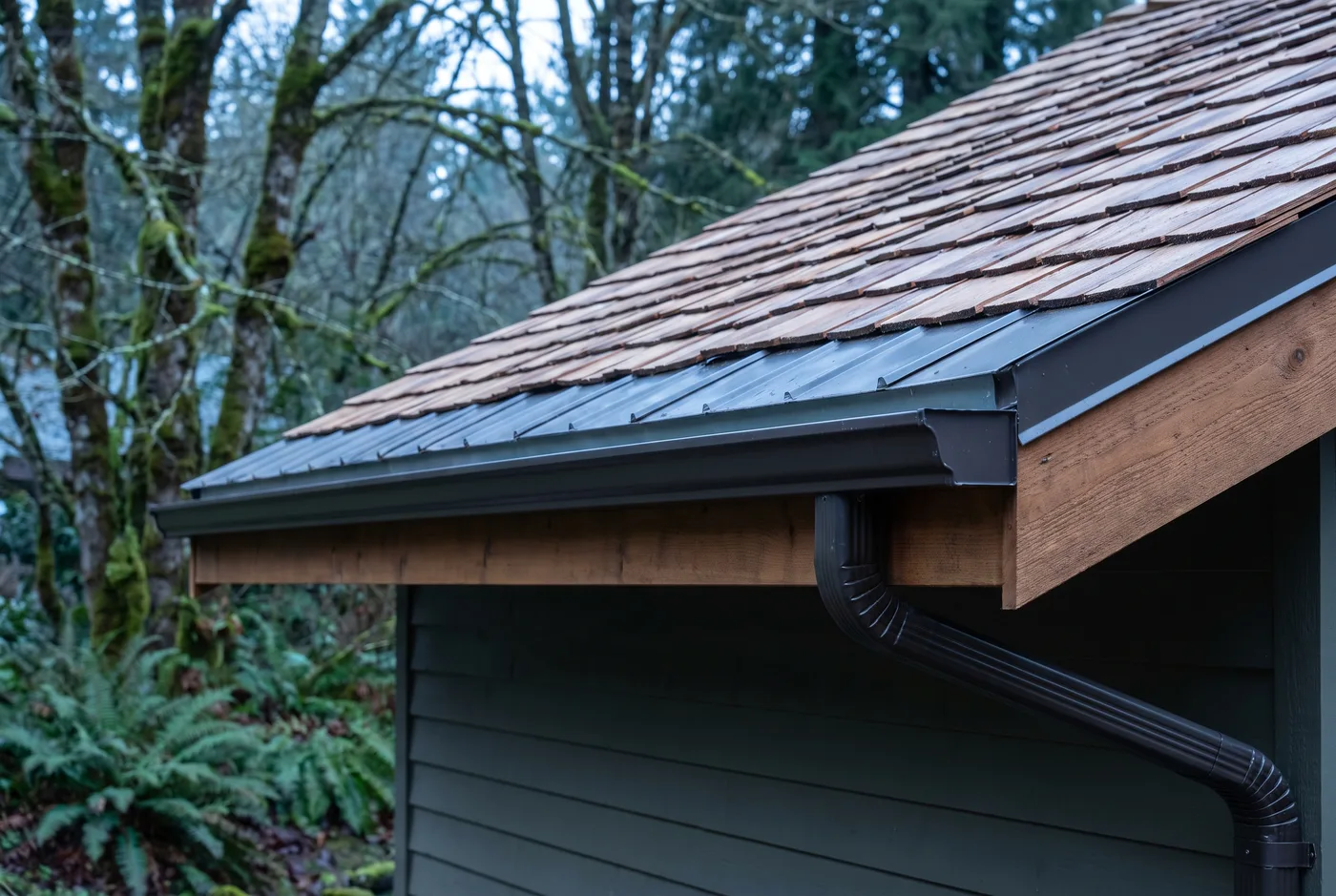
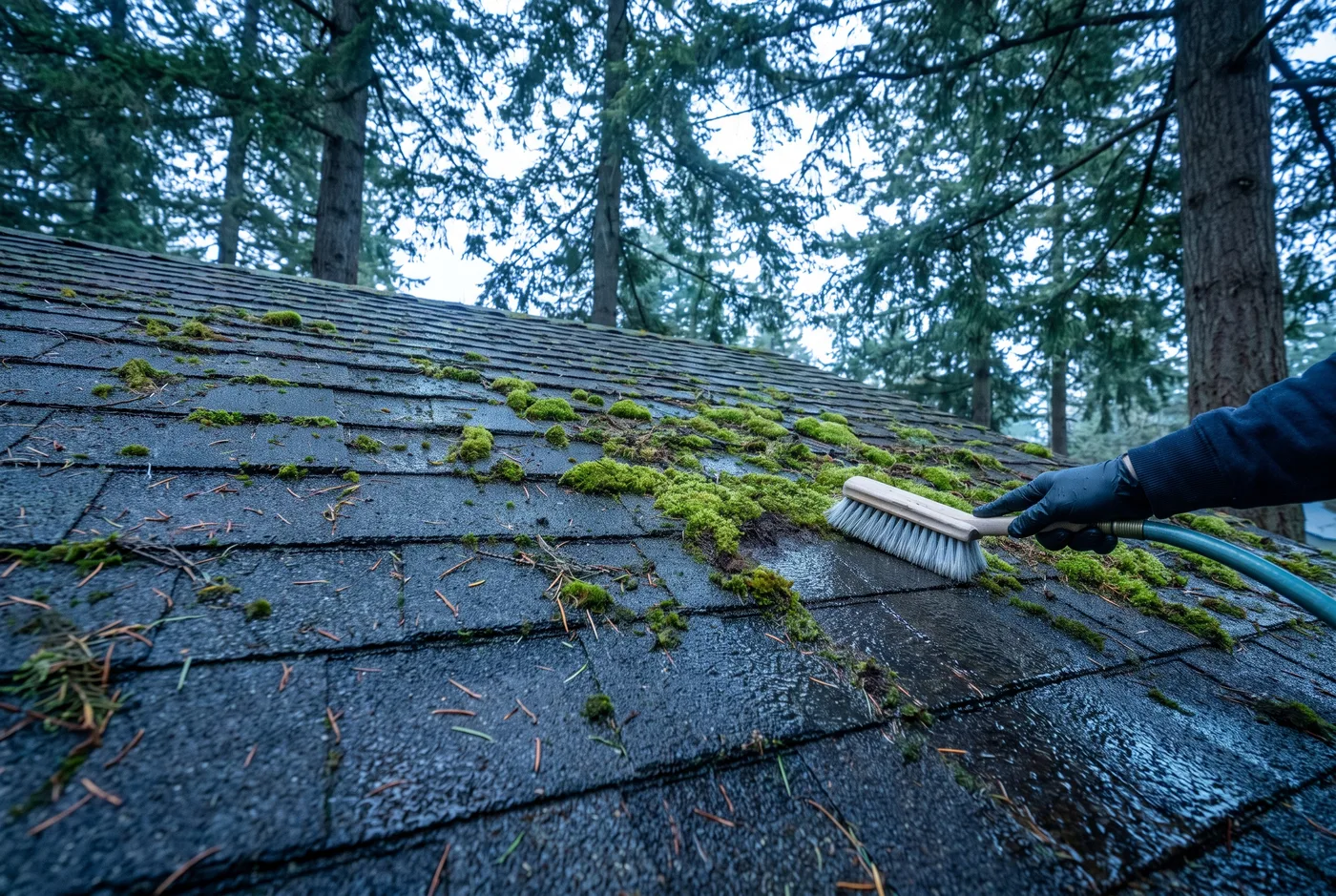
A roof leak is rarely a hole in the middle of the shingles. It’s almost always a failure at a break in the roof — a spot where metal, a pipe, a wall, or a change in slope interrupts the roof plane. These spots rely on flashing and sealant, and flashing is what ages, rusts, and lifts first. Near the water — Bellingham Bay, Birch Bay, Blaine — salt air speeds up rust on cheap fasteners and flashing. Outflow winds and open exposure lift shingle edges and cedar shakes every winter, and up in the foothills, snow load and ice dams work seams loose. Add a shaded north slope under Douglas fir, where moss traps moisture against the roof, and you have the exact recipe most Whatcom homes leak from.
What are the most common roof leak sources and fixes?
The table below covers the sources we find most often across Bellingham, Ferndale, Lynden, Blaine, and the outlying communities. Each is a targeted repair when caught early. These are local ranges for learning — an estimate, not a quote — and a free inspection gives you your real number.
| Leak source | Likely cause | Typical fix | Cost range |
|---|---|---|---|
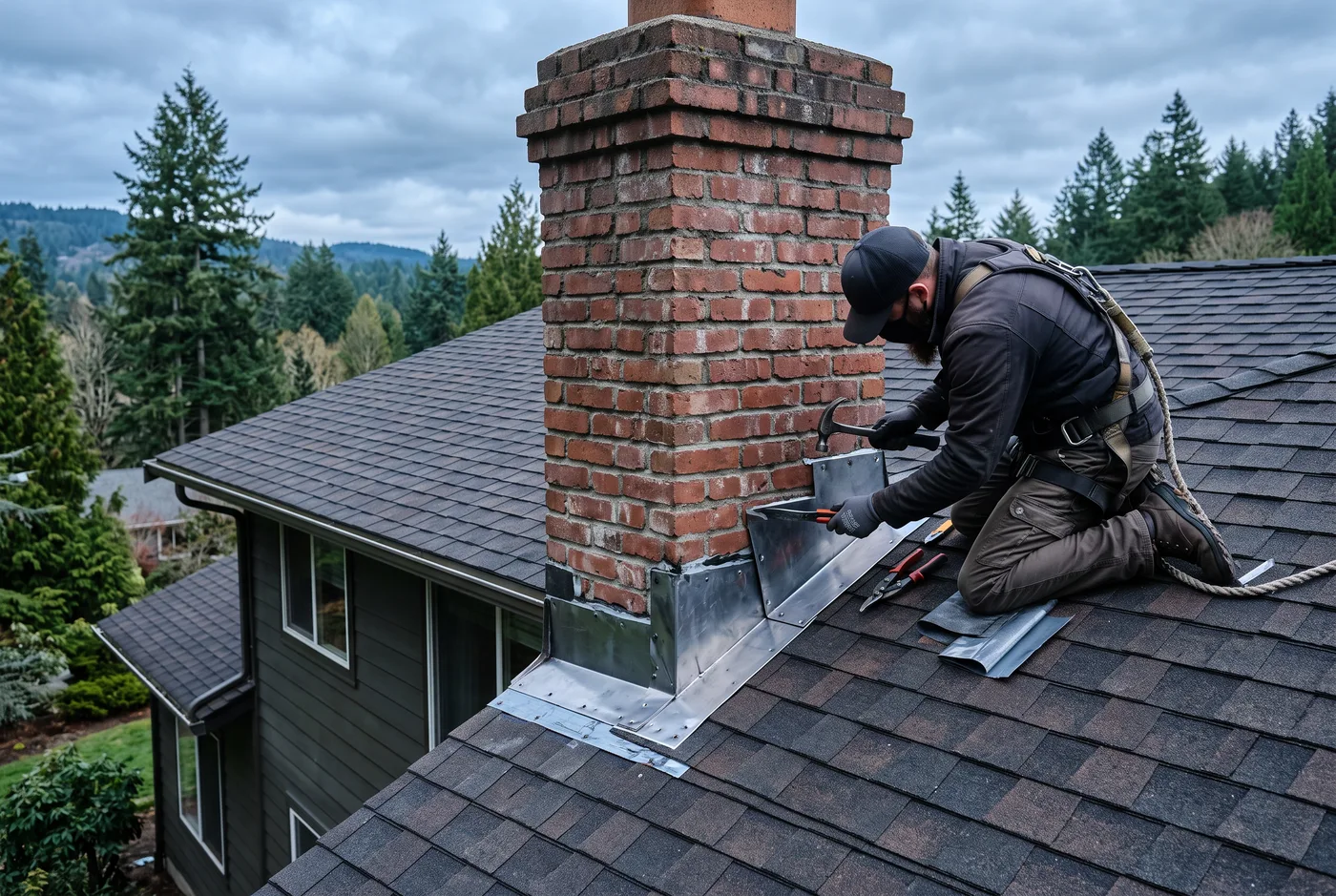
| Roof, step & chimney flashing | Rusted, lifted, or poorly sealed metal at joints; salt-air corrosion near the water | Reflash with rust-resistant metal and reseal joints | $450–$1,800 |
| Pipe & vent boots | UV-cracked rubber collar around a plumbing vent | Replace with a metal or silicone-collar boot | $350–$900 |
| Roof valleys | Debris buildup, worn liner, or no ice-and-water shield | Clear and re-line the valley with ice-and-water membrane | $600–$2,500 |
| Nail pops & backed-out fasteners | Heat cycles and wind working fasteners loose | Reseat or replace fasteners and seal the holes | $450–$1,200 |
| Wind-lifted shakes or shingles | Outflow winds and open exposure on aging cedar or asphalt | Refasten or replace the lifted pieces | $500–$2,500 |
| Skylight flashing | Failed edge flashing or dried-out seals | Re-flash or replace the skylight | $400–$2,500+ |
| Gutters & fascia | Moss and fir debris causing overflow behind the fascia | Clean, repair, and add drip-edge flashing | $1,200–$6,500 |
| Moss on north slopes | Moss holding moisture under shingles or shakes | Gentle treatment — never pressure-wash | $400–$1,600 |
Notice how many of these sit at a penetration or edge rather than in the middle of the roof. That’s why a quick patch over the ceiling stain so rarely works — the water is coming from somewhere else entirely.
Why is my roof leaking when it isn’t raining above the stain?
This is the single most misunderstood thing about leaks. Water follows gravity and the easiest path, not a straight line down. It enters at a lifted flashing or cracked boot, runs along the underside of the plywood sheathing, tracks down a rafter, and only drips once it hits a nail, a seam, or a low point in the framing. By then it can be several feet — sometimes a full rafter bay — from where it got in. Wind-driven rain makes it worse, pushing water uphill under shingle edges during a hard outflow blow. Sometimes what looks like a leak is condensation from poor attic ventilation, which we rule out as we diagnose. The takeaway: the stain marks where the water fell, not where it entered.
How do you find the true source of a roof leak?
Finding the real entry point is what separates a lasting fix from an expensive guess. Here’s the process we use on every leak call:
- Map the inside. We start inside, noting exactly where the stain is, how far it spreads, and which way the framing runs, so we know which way water could have traveled.
- Inspect uphill. We move to the roof and inspect everything above and around the stain — flashing, boots, valleys, skylights, and fastener lines — because the breach is almost always higher than the drip.
- Check the usual suspects first. Rust near the water, cracked boots, moss, and lifted cedar are so common here that we confirm or rule them out before anything rare.
- Run a controlled water test. When the source isn’t obvious, we wet the roof one section at a time and watch inside until the leak shows up. That pins down the exact spot instead of sealing everything and hoping.
- Document and estimate. We photograph what we find and give you a written, local estimate so you see the actual problem, not a sales pitch.
That detective work is the heart of our roof inspections and maintenance service, and on-site inspections and written estimates are free.
Should I repair or replace a leaking roof?
Honest answer: most leaks are repairs. A single failed flashing, a cracked boot, or a handful of wind-lifted shakes on an otherwise sound roof is a simple roof repair. Replacing the whole roof over one bad boot is a waste of your money, and we say so when that’s the case.
Replacement comes up when the pattern changes: many leaks across different slopes, widespread moss rot that has softened the deck, or a roof that’s simply at the end of its life. If your cedar is failing rather than just leaking in one spot, our guide on whether to repair or replace a cedar shake roof walks through the decision in detail. And if the leak traces back to a storm, the storm damage and insurance claims guide explains how coverage usually works. Our job is to give you honest repair-vs-replace advice, backed by a workmanship warranty on whatever we do.
What should I do about an active leak right now?
If water is coming in during a storm, don’t wait. Take these steps first:
- Contain the water inside. Move furniture and valuables clear of the drip, set buckets under the leak, and if the ceiling is bulging with trapped water, pierce it carefully to drain it into a bucket instead of letting it collapse.
- Tarp the breach. Get a tarp over the source if you can do it safely from a stable position — never on a wet, wind-loaded roof.
- Call a local crew. Because our crews are already working across Bellingham and Whatcom County, we can often come the same day. A fast response limits how much inside damage the leak can do.
We serve Bellingham, Ferndale, Lynden, Blaine, Everson, and the Mount Baker foothills, plus outlying communities including Point Roberts, Sudden Valley, and Lummi Island. We treat an active leak as the urgent problem it is.
Stop the leak with an honest Whatcom County roofer
A leak almost never means the roof is done. It usually means one spot failed and needs a real fix, found the right way. Call Glacier Roofing at (360) 483-1333 for honest, local roof leak repair, or reach us through our contact page to schedule a free roof inspection and written estimate. We’ll find where the water actually gets in, tell you straight whether it’s a repair or a replacement, and stand behind the work.
Frequently asked questions
Why is my roof leaking when it isn't raining above the stain?
How much does roof leak repair cost?
Can you find a leak you can't see from inside?
Should I repair or replace a leaking roof?
How fast can you get to me for an active leak?
Ready to move forward?
Talk to a local Whatcom roofer — free inspection, honest advice.