Published July 14, 2026 · by Glacier Roofing
Key takeaways
- Skylights almost never leak through the glass. They leak because the flashing kit, sealant, or the old unit itself has failed.
- A re-flash usually runs $400–$1,200. Replacing the whole unit lands around $900–$2,500+ on a Whatcom County roof.
- Fresh caulk every fall is a patch, not a fix. Proper step-flashing woven into the roofing courses is what stops the leak for good.
- If your roof is due anyway, replacing a skylight during a re-roof is far cheaper than doing it alone later.
- Whatcom County conditions — heavy rain, hard outflow winds, and moss on shaded slopes — make getting the flashing right the first time worth every dollar.
A skylight is the first thing homeowners blame when a winter water stain shows up on the ceiling. It’s almost never the real cause. The glass is fine. The metal and sealant around it are what let go. Here’s what skylight repair and replacement really cost out here, why yours leaks when the November rain arrives, and the fix that actually holds.
Skylights almost never leak through the glass. They leak because the flashing kit, sealant, or the old unit itself has failed. On a Whatcom County roof, a simple re-flash runs about $400–$1,200. Replacing the whole unit usually lands between $900 and $2,500+. The lasting fix is step-flashing woven into your roof, not more caulk.
How much does skylight replacement cost in Whatcom County?
There are really three jobs hiding inside “my skylight leaks,” and the price gap between them is big. The cheapest is a re-flash when the unit is still good. The middle is a full unit replacement. The best value, if your roof is already near the end, is handling the skylight while the roof is open. Here’s how they compare in honest local ranges:
| Skylight job | What’s involved | Typical local range |
|---|---|---|
| Re-flash only (glass & frame still sound) | Strip roofing around the curb, add a new flashing kit and ice-and-water membrane, step-flash back into the courses | $400–$1,200 |
| Replace the skylight unit | Remove the old unit, set a new curb- or deck-mounted skylight, new flashing kit, interior and exterior finish | $900–$2,500+ |
| Replace during a full re-roof | Skylight swapped while the roof is open — shared labor, staging, and disposal | $300–$1,500 incremental |
These are estimates, not quotes. A few things move the figure: roof pitch; whether it’s asphalt shingle, standing-seam metal, or cedar; the size and type of skylight; and how easy the roof is to access. A free roof inspection gives you your real number before anything is scheduled. As a rule, these fixes fall inside the same range as most of our roof repair work — $450 to $3,500 — with a full unit swap at the higher end.
Why does my skylight leak?
Because water is patient and gravity always wins. When a skylight leaks, the water is almost always getting past one of three things. None of them is the glass:
- A failed flashing kit. The metal apron, head flashing, and step pieces that tie the skylight into the roof corrode, lift, or were never installed right. This is the number-one cause, and salt air near the water speeds it up.
- An old unit. Older skylights fog between the panes, crack, or lose the rubber gaskets that seal the glass to the frame. Once the seal is gone, no flashing repair will keep it dry.
- Bad or aging sealant. An old “fix” that leaned on caulk instead of flashing. It looked dry the day it was done, then started weeping again the first hard winter.
Our weather finds every one of these fast. Whatcom County gets about 35 inches of rain a year in Bellingham — far more up in the foothills — heaviest in November. Hard outflow winds funnel down the Nooksack and Fraser valleys and drive rain sideways, up, and under any flashing that isn’t lapped right. On shaded north slopes under the Douglas firs, moss holds moisture against the curb and works into seams. A skylight that would easily handle Seattle drizzle gets tested hard here.
Why does “caulk it every fall” always fail?
Because caulk is a gasket, not a roof. It’s a soft bead of sealant asked to do the job of overlapping metal, and it fails right on schedule. Sealant swells and shrinks with every hot-then-cold day, dries out in summer, and cracks in the sun. By the time the November storms roll in, the bead you laid down in September has tiny cracks. Wind-driven rain finds every one. So you re-caulk, it holds for a season, and you’re back on the ladder next fall. That’s not maintenance. That’s a subscription to a leak.
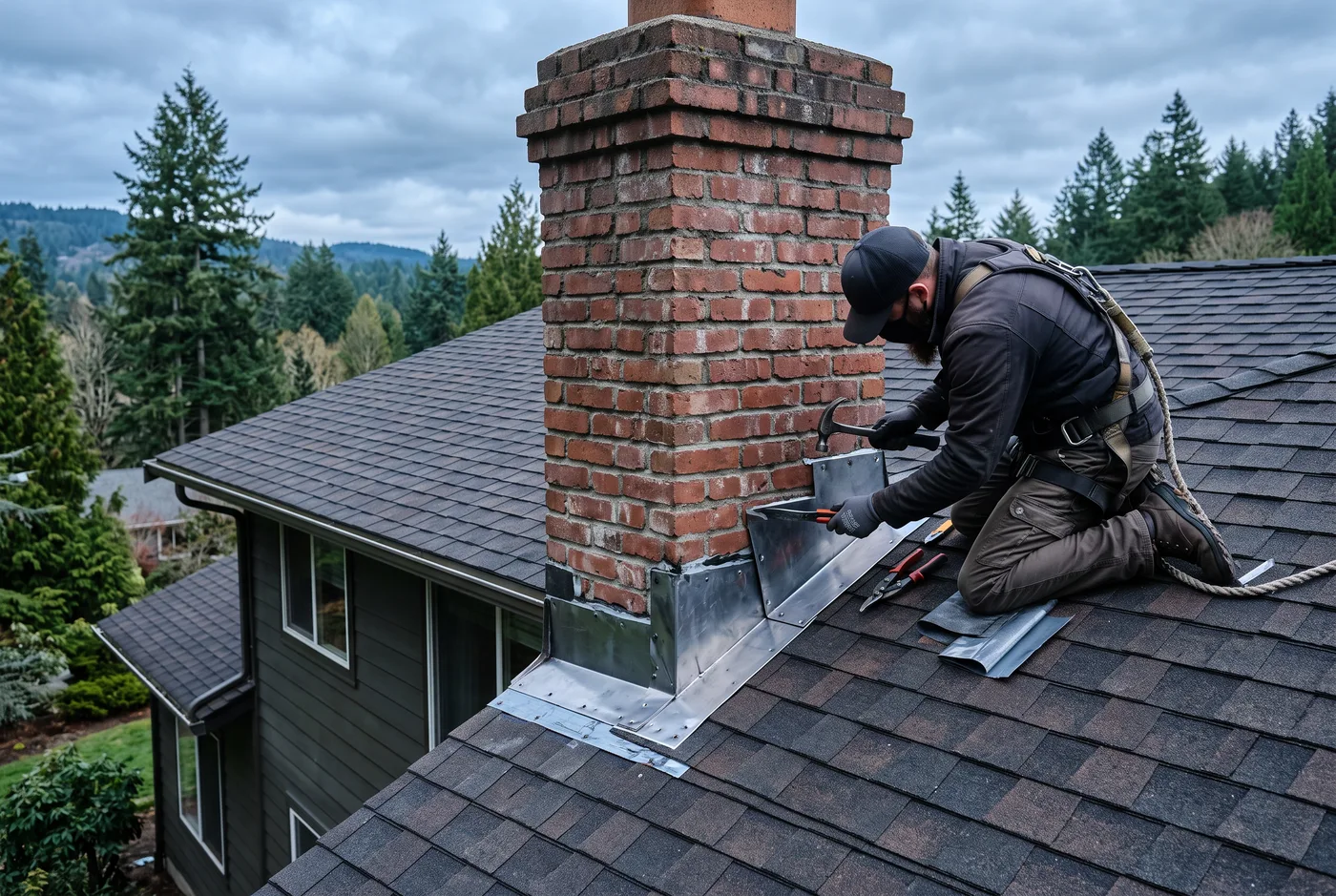
Proper step-flashing works a whole different way. It sheds water by lapping metal in the same direction the roof does. Gravity carries water over each piece instead of into a seam. Nothing depends on a sealant staying flexible for 20 years. Here’s how a real skylight re-flash goes in:
- Strip the roofing around the skylight curb — shingles, or the panels on a metal roof — back far enough to work.
- Lay ice-and-water membrane around the curb and up the sides. It’s the same self-sealing barrier we run at valleys and eaves in this wet climate.
- Install the head, sill, and step flashing so each piece laps under the course above and over the course below. This weaves the skylight into the roof instead of letting it sit on top.
- Re-lay the roofing over the flanges, so the flashing ends up fully tied in and hidden.
- Finish and inspect — a light bead of sealant only where the maker calls for it, never as the waterproofing itself.
That’s the difference between a repair that lasts one season and one that outlives the ceiling stain. Want the deeper version? Our guide on tracking down a roof leak and our flashing repair guide walk through how we find the true source before anyone touches the skylight.
Re-flash or replace — how do you decide?
Honest repair-vs-replace advice is the whole point of a free inspection, and skylights are no different. The deciding question is simple: is the unit itself still good?
- Re-flash when the glass is clear, the frame is solid, and the leak traces to failed flashing or sealant. Why pay for a new skylight when the one you have works?
- Replace the unit when the glass is fogged or cracked, the gaskets are shot, or the skylight is just old. Flashing a dying unit back in only means doing the work twice.
- Replace during a re-roof when the roof is near the end of its life. This is the smart-money move, and it deserves its own section.
We won’t push a new skylight on you to dodge a fiddly flashing job. And we won’t band-aid a fogged unit that’s going to fail next winter. You’ll get the straight version.
Should you replace a skylight during a re-roof?
If your roof is due anyway, this is where the real savings are. During a full roof replacement, the roofing around the skylight is already off, the crew is already up there, and the disposal and material staging are already covered by the bigger job. Adding a new skylight then is often just $300–$1,500 on top. That’s a fraction of the $900–$2,500+ a standalone replacement runs later.
There’s a quality reason too, not just a cost one. Adding a skylight to an existing roof means cutting into finished courses. Putting one in during a re-roof means it gets step-flashed into brand-new roofing as the roof goes on. That gives you a skylight that’s part of the system from day one, instead of the one weak spot in an otherwise fresh roof. If you’re already weighing a new roof, read our cost of a new roof in Whatcom County breakdown and fold the skylight choice into it. The same goes for gutters and flashing — do the whole water-shedding system while access is easy and cheap.
Get a straight answer on your skylight
Maybe you’ve got a winter stain in Bellingham, a fogged unit in Ferndale, or a planned re-roof in Lynden with skylights to sort out. Either way, the honest answer starts with a look. Our roof inspections and written estimates are free. We’ll tell you plainly whether you need a re-flash, a new unit, or to wait and handle it during your next roof.
Call Glacier Roofing at (360) 483-1333 or reach out through our contact page. We’re a licensed, bonded, and insured Whatcom County contractor. We back our work with a workmanship warranty, and we’ll build the job around your schedule.
Frequently asked questions
Why does my skylight leak every winter?
Should I replace my skylight during a re-roof?
Can you just re-flash my skylight instead of replacing it?
How much does skylight replacement cost in Whatcom County?
Do skylights always leak eventually?
Ready to move forward?
Talk to a local Whatcom roofer — free inspection, honest advice.