
Published July 27, 2026 · by Glacier Roofing
Key takeaways
- Most metal-roof leaks in Whatcom County are at fasteners, flashing, and panel laps or penetrations — not through the steel itself.
- Exposed-fastener panels leak as neoprene washers age and back out; standing-seam roofs usually leak at flashing and penetrations, not the seams.
- Near saltwater, corrosion at cut edges and cheap fasteners is the accelerator — we swap in corrosion-resistant fasteners and re-detail flashing.
- A sound panel field with failed fasteners or flashing is a repair; widespread corrosion or coating failure points to recoat or re-roof.
- Don't seal a metal roof with the wrong sealant — incompatible caulk fails fast and can void coating warranties.
Metal roofs in Whatcom County almost never leak through the steel — they leak at the details: fasteners, flashing, panel laps, and penetrations. Exposed-fastener panels leak as their neoprene washers age and back out; standing-seam roofs leak at flashing, valleys, and pipe boots, not the seams. If the panel field and coating are sound, that's a repair — corrosion-resistant fasteners, re-detailed flashing, and a metal-compatible sealant at the true source. Only widespread corrosion or coating failure calls for a recoat or re-roof.
Metal is the roof most Whatcom County homes should be on — it sheds our heavy rain, resists moss, and stands up to our hard outflow winds and foothill snow load. But even a good metal roof needs repair eventually, and when it leaks, homeowners are surprised because the panels look perfect. They usually are. The leak is somewhere else.
Where metal roofs actually leak
- Fasteners (exposed-fastener panels) — the rubber washer under each screw hardens and backs out with years of thermal movement. One roof can have thousands of screws; a handful of failed washers is enough to leak.
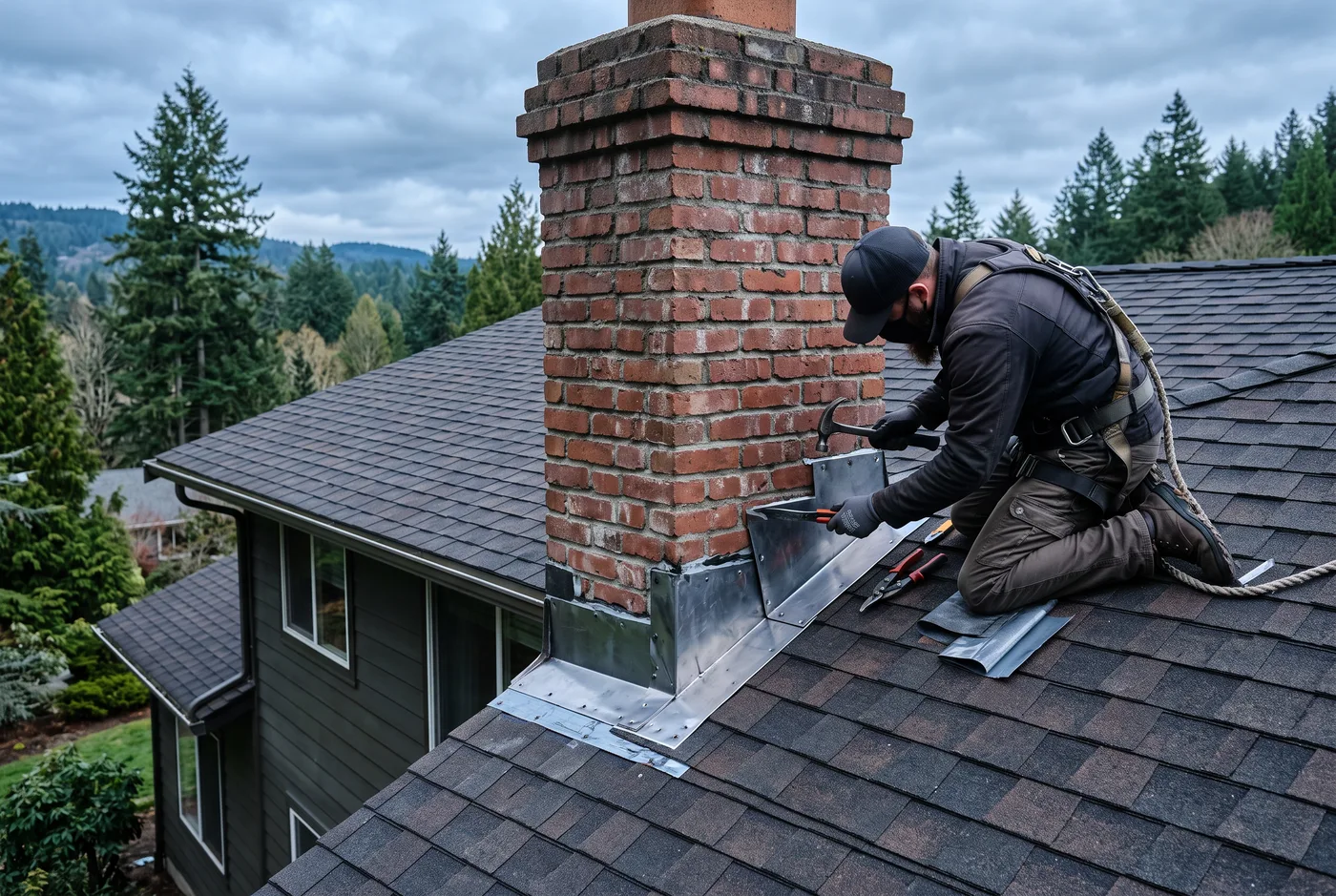
- Flashing — at chimneys, skylights, walls, and valleys. Flashing ages, lifts, and opens before the panels do.
- Pipe boots and penetrations — the rubber cracks in UV and salt air.
- Panel laps and cut edges — where corrosion starts near saltwater if cheap fasteners or unfinished edges were used.
Standing-seam roofs are the most watertight metal system we install, and their concealed seams rarely fail. When a standing-seam roof leaks, it’s nearly always the flashing or a penetration — which is good news, because those are repairs.
The salt-air factor
Within a few hundred feet of saltwater, the enemy is corrosion at cut edges and at builder-grade fasteners — not the coated field of the panel. When we repair a coastal metal roof we upgrade to corrosion-resistant fasteners and coastal-rated flashing so the fix survives the same air that caused the problem. If you’re planning a new roof near the water, that’s why we spec heavier 24-gauge panels with marine-grade Kynar 500 coatings on our metal roofing jobs.
Repair vs. re-roof
A sound panel field with failed fasteners or flashing is a straightforward roof repair. Widespread edge corrosion, coating failure across the field, or panels damaged by foot traffic point toward a recoat or a re-roof in a heavier salt-zone system. We give you the honest call with photos — and we never push a re-roof to avoid a repair we could stand behind.
One warning: don’t reach for hardware-store caulk. The wrong sealant fails within a season and can void a coating warranty. If it’s actively leaking, tarp it and call us — a correct metal repair fixes the source with the right hardware, not a smear of the wrong sealant over the symptom.
Frequently asked questions
Why is my metal roof leaking if the panels look fine?
Can a metal roof be repaired, or do I need a whole new roof?
Does salt air ruin metal roofs in Whatcom County?
How much does metal roof repair cost in Whatcom County?
Should I just caulk the leak myself?
Roof Repair in Whatcom County
Local Whatcom crew, free on-site inspection, honest repair-vs-replace advice.